Detours and Diagnoses: Facing Multiple Sclerosis
By: Tricia Chérie
[Initially published on October 28, 2017]

At 28, I felt the road ahead would be filled with joy and milestones: seeing my fiancé’s face light up as I walked down the aisle, celebrating the hard-earned completion of my master’s degree, or embarking on a cross-country adventure. Instead, life threw me an unexpected curveball that would redefine everything.
My defining “moment” was devastating: no Facebook update, no party, hell I barely wanted to talk about it, but here it goes.
It all started four months ago over a game of rummy. After dealing the cards between myself and my other half, Cliff, I realized I couldn’t read the suit or number from across a small coffee table.
It hadn’t happened all at once. I had noticed minor changes in my vision for a while at that point, but that night, it was different: my vision blurred, my head pounded from straining my eyes, and white lights danced in my peripherals. Even still, I wasn’t too worried; I figured I would get a new prescription and maybe even some stylish new frames. I took this blind confidence to my local optometrist the following morning.
Within five minutes of my appointment, it became evident that my left eye was doing all the work. A primary vision test confirmed that I was legally blind in my right eye. I was stunned—who loses their sight overnight?
My optometrist’s usually light, friendly voice shifted as he explained my optic nerve inflammation, which, outside of inducing my sudden vision loss, could be linked to various serious medical issues. Next stop? The Emergency Room.
Sitting in the waiting room for hours, Cliff and I had plenty of time to look at what could be wrong, but after a while, we just started watching cute cat videos and joking. Our optimistic deduction? My optometrist’s insistence on heading straight to the ER was unfounded- a clerical oversight.
Internally, I was panicked; WebMD wasn’t giving many good options. I mean, there is nothing to laugh about when it comes to a potential brain tumor.
“Patricia Callahan?” a faceless nurse called out to the crowded waiting area, clutching her clipboard like a long-lost friend. I let out an audible sigh, eager to get this all over with.
The empty white walls, the fresh pine scent of the recently cleaned linoleum, and the harsh fluorescent overhead lights made me nauseous. Once we left the waiting room, we went to a small room separated by curtains and waited some more. My stomach eventually settled. Singing songs under my breath and trying to maintain an upbeat facade, my anxiety slowly built.
After about an hour, someone came to take my blood without explaining why. The nurse’s curly hair frizzed around her jawline, and though her eyes seemed kind, I didn’t want her near me or my veins. My veins, visual markers of my mortality, recoiled so much that the nurse had to hunt them down with an ultrasound machine.
After numerous painful attempts, the IV ended up in the crick of my right arm. This foreign, clearly unwelcome object clung to me, leaving me with an irrational sense of violation. The fact that I had never been to a hospital until now only exacerbated how uncomfortable the interaction was.
After drawing a vile of blood to add to a blood collection, for all I knew, I was told, much to my dismay, that the IV was going to have to stay in. After taking a deep drag of the Lysol-drenched air, my uneasiness held most of my breath in the back of my throat. Only when the doctor finally made an appearance did I finally let out a complete exhale. My relief was, unfortunately, short-lived.
Instead of an apology for the misunderstanding and a free lollipop for my troubles, I was wheeled back to the MRI machine at the request of the doctor.
A male nurse wheeled me through busy hallways. I was hard-pressed not to absorb the frantic energy of the medical personnel as we passed. The hospital’s typical Tuesday evening shift had me sweating, and I wasn’t doing a damn thing. I was eventually left outside a small office in an even smaller waiting room.
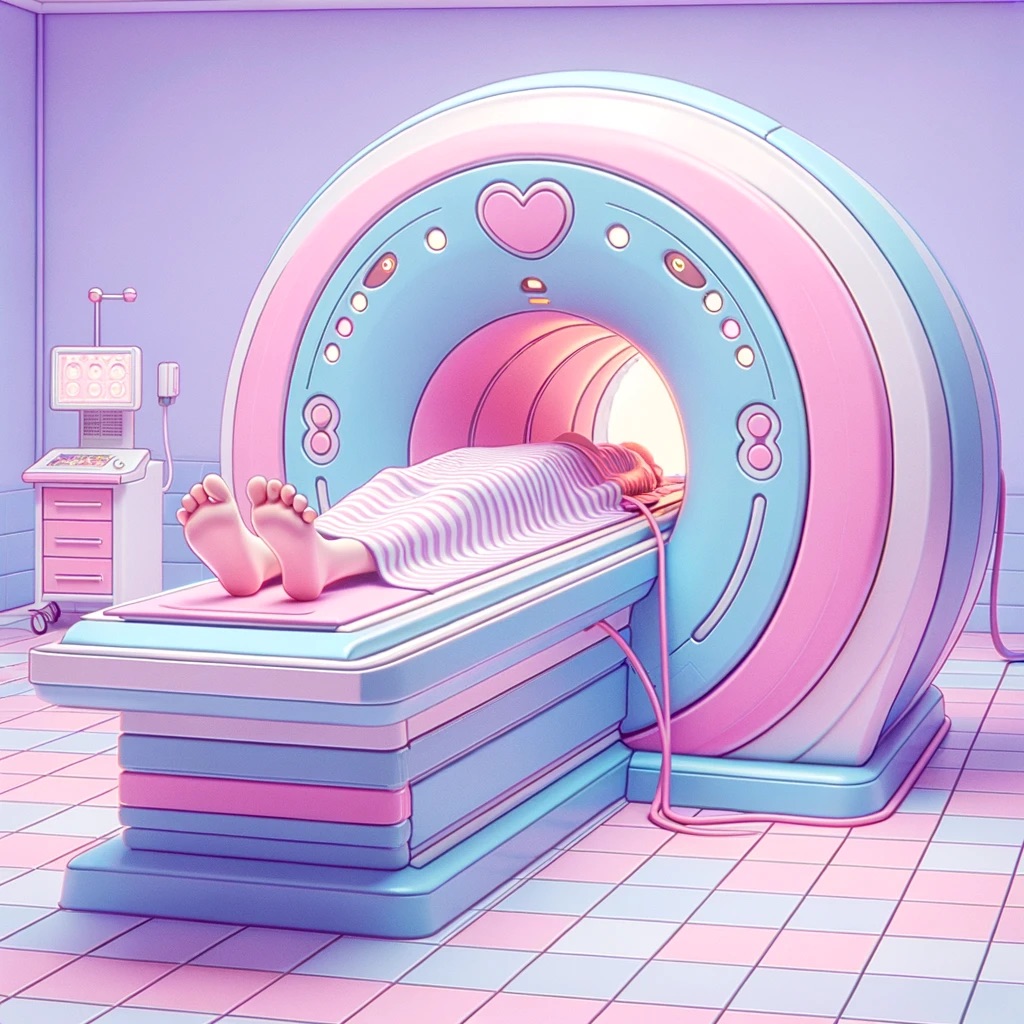
It was 10 p.m. before I was loaded into the MRI machine. My technician had just come back from his break. The smell of Chinese food filled the room. I could taste it through his latex gloves as he put gauze under my cheeks before placing a foam helmet on my head.
For the next hour, I would lay like the trapped specimen I was while a machine yelled at me. Why was I even getting an MRI? I didn’t have a clue— Was this machine going to prove I had a brain tumor? Was I going to fulfill Web MD’s worst-case scenario?
After the first 35 minutes, my body and psyche accepted the constant buzzing and shaking, and I allowed my exhaustion to take over. My rest was only interrupted when I felt a light squeeze on my toes before being released from the coffin-like capsule.
Once I was wheeled back to my original makeshift room— where heavy-duty white shower curtains were the only barrier between myself and the other patients— I waited with a knot in my stomach for my MRI results.
Of the whole ordeal, this bit of the night goes by quickly. The doctor came to his professional prognosis: I had Multiple Sclerosis.
He said it so plainly, like putting butter on his bagel. He patted my shoulder, repeating, “It’s treatable,” which I’m sure from his perspective was terrific news. In retrospect, I can completely understand where he was coming from, but at the time, I was overwhelmed because I knew right then my life would never be the same.
My face flushed around my puffy eyes while my expression scrunched into a scowl. I was fuming. Looking away from the doctor and Cliff, I let tears slowly roll down my cheeks. After the doctor finally left, sliding the curtain gently closed to give us that false sense of privacy. That was when my guttural sobs escaped, and I didn’t stop them.
The following two days in the hospital were a bizarre blur, complete with confusion, anger, and sleeplessness. You never knew when the next round of steroids was coming or when the phlebotomist would need three more vials of blood. And eventually, after days of tapering down the steroids via capsule form at home, my sight was all but back to normal.
Unfortunately, two weeks later, I started to experience all new symptoms: feelings of numbness, slurred speech, and reoccurring unwarranted fatigue. I could go on, but the truth is MS never goes away, and at that point, you would have my life story, so I’ll spare you.
Finding an overall purpose for sharing this anecdote felt impossible. Sparing clichés and inspirational chatter, all that remained was the black hole of uncertainty. The truth is I’m scared. I am afraid of a file cabinet of unknown symptoms and neurological repercussions that Multiple Sclerosis may blindside me with on another idle Tuesday evening.
Yet, forward, I march through good days and bad. My fingers recoil in pain as I type, but I keep typing. And I guess, in the end, I wrote this for me because I refuse to be afraid, especially of living.
6 years, 7 months, and 16 days later
2024 Update
Since my diagnosis, I’ve embraced a more positive outlook on life. Despite the challenges that multiple sclerosis (MS) presents, I’ve found that over time my real strength has revealed itself.
After discovering Kesemptia, a monthly at-home injection for relapsing multiple sclerosis (RMS), I have been able to keep my symptoms at bay and prevented progression.
The medication effectively helps the B-cells in the lymph nodes remember not to attack the myelin, the protective covering around the nerves in the brain and spinal cord. It seems this mysterious disease is perpetuated by a bit of body function miscommunication. Scientists know enough to know it isn’t contagious but how its contracted and how to cure it those are big open ended questions at the moment.
Since stabilizing my symptoms, I have walked down the aisle, am working toward my graduate degree in American journalism at NYU, and plan to travel cross-country to California later this year. These milestones remind me that while MS is a part of my life, it doesn’t define it. Navigating these changes and continuing to pursue my dreams has shown me the importance of focusing on what I can control and cherishing the moments of joy and accomplishment along the way.
I’m not claiming it’s easy—much like any hardship in life, hindsight is 20/20. But hold fast because anything is possible. As long as there is breath in your lungs, you can still make your dreams come to fruition. Don’t accept defeat because of arbitrary deadlines for certain life milestones. You’re in charge of your timeline—They are your milestones, after all.
If you or someone you know is exhibiting any symptoms associated with multiple sclerosis (see image below), I strongly suggest a quick trip to a neurologist to rule it out.
 “Multiple sclerosis affects various parts of the body, leading to symptoms such as cognitive changes, fatigue, muscle weakness, and more. Understanding these effects is crucial for early diagnosis and management.”
 No Apologies
Leave a comment