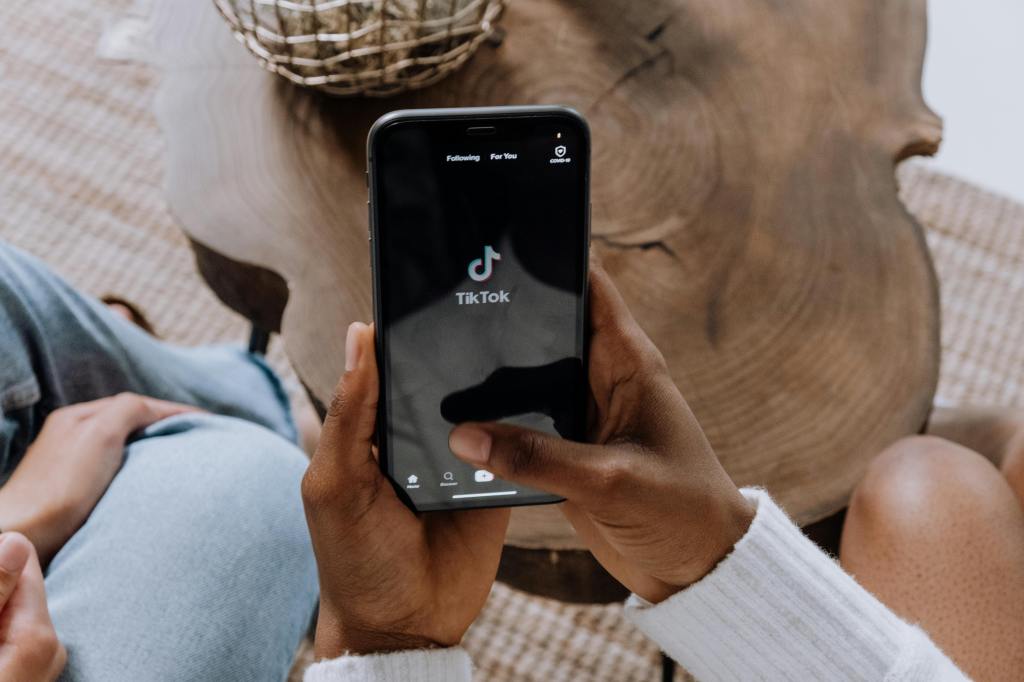
The TikTok Tango: A Cautionary Tale of Bans, Backlash, and Digital Power Plays
On June 29, 2020, without warning, TikTok vanished—wiped from app stores, blocked by internet providers, and completely shut down overnight. India swiftly banned the app, leaving 200 million users adrift and shaking up the global social media landscape.
Now, the U.S. faces a similar crossroads. A new law demands that ByteDance either sell TikTok or face an outright ban. But unlike India—where the decision was swift and politically charged—the U.S. process is tangled in lawsuits, congressional showdowns, and Big Tech interests.
Beyond the courtroom drama, what would a TikTok ban actually mean for everyday Americans?
If India’s experience is any clue, creators will lose their audiences, businesses will lose a vital marketing tool, and no real replacement will emerge. A ban wouldn’t just remove an app—it would disrupt livelihoods, reshape digital culture, and sever a generation from a platform that has redefined influence, activism, and opportunity.
India’s TikTok Ban: A Cautionary Tale
By Smriti Mamgain, New Delhi, India
TikTok’s Meteoric Rise

In 2017, Instagram had already become India’s go-to platform for polished, curated, and elite content. But for much of India—small-town creators, regional entertainers, and everyday users—Instagram felt unreachable, a world away from their reality.
Then came TikTok.

Riyaz Ali, born Riyaz Afreen in Jaigaon, began posting lip-sync videos in 2017 and quickly soared to TikTok fame, amassing 45 million followers. His charisma and style made him one of the platform’s top teen influencers, earning an estimated $700,000 a year—an unheard-of feat before TikTok.
And he wasn’t alone. TikTok became a launchpad for local businesses, Bollywood promotions, and political campaigns, bridging the gap between grassroots content and mainstream visibility in ways Instagram and YouTube never had.
Then, just as quickly as it arrived, it vanished.
The Ban That Changed Everything
On June 29, 2020, India’s TikTok stars woke up to find their accounts—and livelihoods—gone. The Indian government, citing national security concerns, banned TikTok and 58 other Chinese apps overnight.
But this wasn’t just about cybersecurity.
Two weeks earlier, a deadly border clash between Indian and Chinese troops in Ladakh’s Galwan Valley had left 20 Indian soldiers dead. In the wake of escalating tensions, the ban became as much a geopolitical move as a digital crackdown—a statement against China, played out in the tech industry.
For creators, the fallout was swift and brutal:
- Millions lost access to the audiences they had spent years building.
- 2,000 employees at TikTok India were suddenly out of work.
- Digital marketers scrambled as ad campaigns worth millions disappeared overnight.

(📷: Flickr.com)
For many everyday Indians, TikTok had been more than entertainment—it had been a lifeline. The app provided financial independence to working-class creators, regional performers, and small businesses who found an audience for the first time.
Meanwhile, ByteDance, with no path forward in India, quietly shut down operations in early 2021. Some employees found work with local competitors, but many left the industry altogether.
India’s TikTok vacuum quickly became a battleground for Big Tech and homegrown startups. Despite the rise of homegrown alternatives like Moj and Josh, no platform has managed to replicate TikTok’s cultural dominance.

The U.S. TikTok Ban: Security Threat or Power Grab?
By Tricia Chérie, Virginia, U.S.A.
Why Is the U.S. Pushing to Ban TikTok?
The push to ban TikTok in the U.S. has been framed around familiar buzzwords—national security, data privacy, and foreign influence—yet the reasoning has left many Americans skeptical.
Former FBI Director Christopher Wray called TikTok a “national security concern,” warning that ByteDance could manipulate its algorithm and harvest user data. “The Chinese intelligence services could access all that,” he cautioned, fueling fears that Beijing could tap into American user information.
But if the government truly cared about data privacy, why hasn’t it cracked down on data brokers who legally sell American user data every day? Meanwhile, 52% of U.S. TikTok users get their news from the app, a number that has more than doubled since 2020, while platforms like Facebook, X, and Google continue harvesting and monetizing data without the same scrutiny.
Critics say the push to ban TikTok is just a distraction from the real issue—America’s failure to pass meaningful data privacy laws.
As Evan Greer put it in a CNN opinion piece:
“The rush to ban TikTok – or force its sale to a US company – is a convenient distraction from what our elected officials should be doing to protect us from government manipulation and commercial surveillance: passing basic data privacy legislation.”
Evan Greer, CNN opinion piece (2023).
But while Washington debates, millions of creators, small businesses, and independent journalists face uncertainty. Support for a ban has dropped from 50% in March 2023 to just 32% by summer 2024, highlighting a growing divide: 42% of Republicans still back a ban, compared to just 24% of Democrats.
Trump’s Flip-Flop & TikTok’s Return
After the Supreme Court upheld the ban, TikTok went dark in the U.S. By 10:00 p.m. EST on January 18—just hours before the ban was officially set to kick in—170 million Americans suddenly found themselves locked out, met with an unwelcome pop-up message.
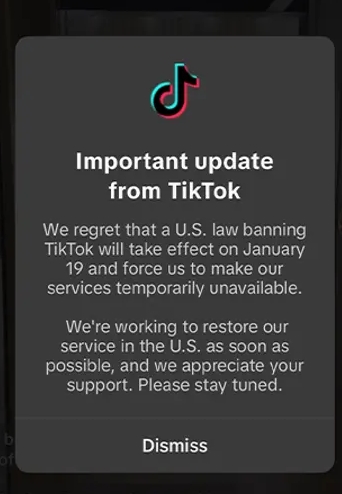
Blackout notification (📷: TikTok)
The ruling forced ByteDance to either sell TikTok or exit the U.S. market. In the aftermath, other ByteDance-owned apps, including Lemon8 and CapCut, were also removed from app stores.
Hours later, a new message appeared:

Initially pushing to ban TikTok in 2020—just weeks after TikTok users sabotaged his Tulsa rally by inflating RSVP numbers before ghosting the event—Trump made a dramatic U-turn during his 2024 campaign. Realizing the app could fuel his obsession with public adoration, court young voters, and settle personal grudges, he embraced TikTok instead.
Now, Trump is positioning himself as TikTok’s savior. His intervention is sparking debate: Is he protecting free speech and digital commerce or leveraging TikTok for political gain?
For now, TikTok’s future remains uncertain, and without a deal, its shutdown could become permanent.
The Bigger Picture
A TikTok ban wouldn’t just remove an app—it would reshape how Americans consume news, amplify voices, and build communities.
In an era where mainstream media filters narratives, TikTok has given everyday users direct access to on-the-ground reporting, activism, and subcultures. If history is any indication, creators will find new ways to connect—but the battle over digital influence is far from over.
Because in the end, this fight isn’t just about TikTok—it’s about control, influence, and the future of digital culture.
Editor’s Note: All statistics cited in this article were sourced from the Pew Research Center report, “8 Facts About Americans and TikTok,” published on December 20, 2024. Full report available here: Pew Research Center.
Correction 2/13/25: A previous version of this article incorrectly stated that Instagram influencer Riyaz was from Bhutan; he is from a town in West Bengal, India, near the Bhutan border.
 No Apologies
Leave a comment