Reinvention culture collapses every year—and the attention economy is counting on it.
New year, new habits, new body, new mindset. Resolutions become virtues. Transformation becomes proof.
Yet as we move into February 2026, it’s clear that many resolutions made in good faith have already unraveled.
We set screen-time limits and watch the weekly reports creep past them, hours logged on Instagram and TikTok. We resolve to read a book a week, only to leave it half-finished as notifications compete for the same narrow pockets of quiet. We plan to eat better, stick to it briefly, then feel restraint erode under exhaustion and convenience. We commit to exercising regularly, feel better almost immediately, and still struggle to sustain the routine—not from laziness, but because modern life already demands constant optimization. Even self-improvement has become a performance metric.
New Year’s resolutions fail so predictably that the numbers barely surprise us. Roughly a quarter are abandoned within the first week. By the end of January, most have given up. Fewer than 10 percent believe their resolutions will last three months.
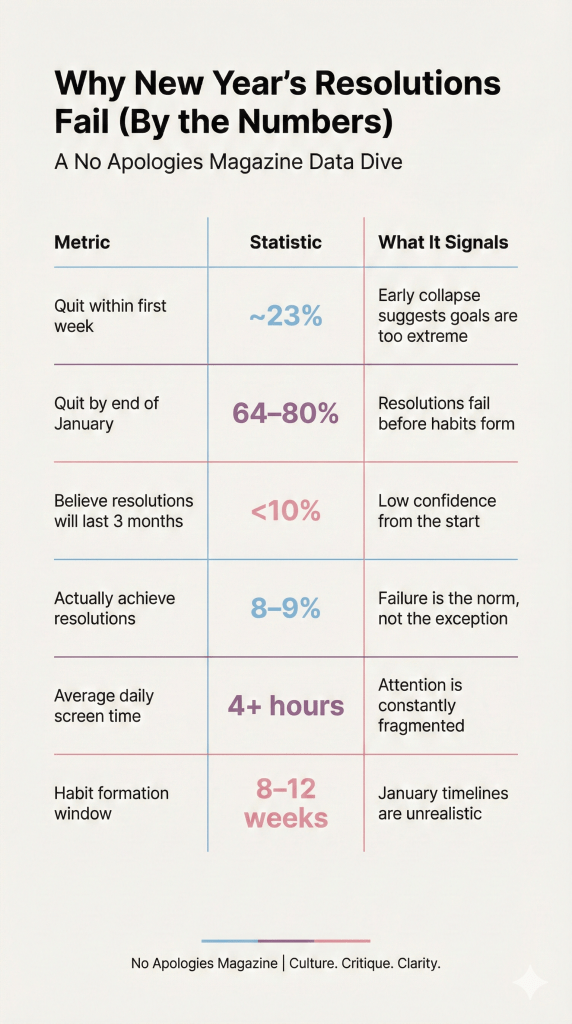
What matters more than the failure rate is the expectation of failure. We enter January already bracing for collapse.
That’s because resolutions aren’t built like habits. They’re built like content.
They’re extreme, aesthetic, and outcome-driven: go five days a week, lose 20 pounds, read 52 books. They follow the same logic as platforms and algorithms—fast results, visible transformation, total commitment. Anything less feels like falling behind.
Psychology explains part of this: goals that are too large, outcomes prioritized over behavior, lapses treated as defeat. But psychology alone doesn’t explain why this cycle repeats every year.
Culture does.
Long before the internet, January was marketed as a rebrand season. What’s changed is the scale. When resolutions fail, the system doesn’t break. Like the human psyche, it refreshes—resetting the feed, offering new routines, selling the promise again.
The change that endures doesn’t fit into a 30-day challenge or a before-and-after slide. It looks like reading for 20 minutes instead of finishing a book a week. Walking twice a week instead of training like an athlete. Showing up again without fanfare.
January doesn’t fail us. The fantasy does.
Real change isn’t triggered by the calendar flipping. It’s built through small shifts and consistency—unglamorous, incremental, and sustainable. It doesn’t require a new year or a membership or a public declaration. It just requires deciding, on an ordinary Tuesday, to begin again.
Real change doesn’t trend. It survives.
 No Apologies
Leave a comment