
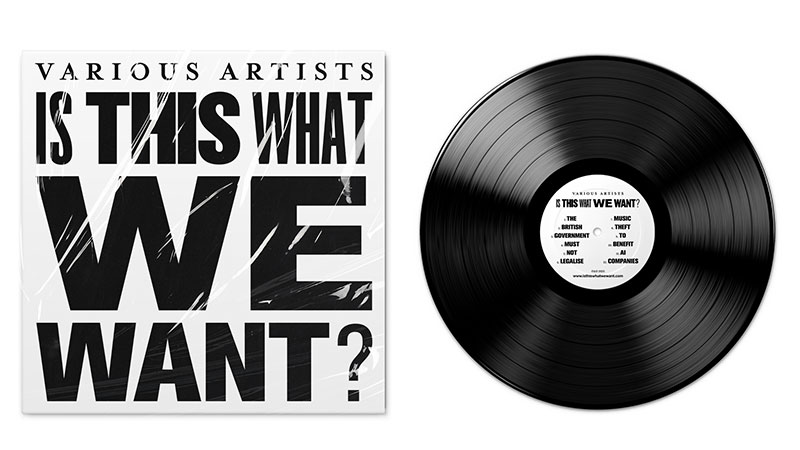
When you think of a protest album, either here in the States or abroad, it’s usually a compilation of songs addressing larger social or political issues. I’m thinking RØRY’s Restoration, which takes on war and trans rights, or Hour of Reprisal’s Endless War, Endless Peace, critiquing government complicity in global conflicts. But it’s hard to think of any protest albums that have been released for the sake of the music industry itself—an album demanding that artists retain explicit ownership of their work in the face of AI exploitation.

That’s exactly what over 1,000 musicians—including Annie Lennox, Kate Bush, Damon Albarn, The Clash, and Hans Zimmer—set out to do with Is This What We Want?, a silent album clocking in at 47 minutes of white noise and empty studio sounds. This unconventional release is a stark warning—an eerie glimpse into a future where AI-generated music replaces human musicians altogether.
Unlike traditional protest records filled with hard-hitting lyrics and charged instrumentals, Is This What We Want? offers a raw slice of the recording process itself—free of vocals, guitar riffs, or beats. Instead, the album leans into studio noise and silence, a powerful statement on what could be lost if AI-driven music is allowed to dominate the industry.
A “Wholesale Giveaway” of Artists’ Rights
The stakes are high. In an open letter to The Sunday Times, a coalition of artists warned:
“The proposal is wholly unnecessary and counterproductive, jeopardizing not only the country’s international position as a beacon of creativity but also the resulting jobs, economic contribution, and soft power—especially harming new and young artists who represent our nation’s future.”
These musicians argue that Britain’s 300-year-old copyright system is one of the reasons the UK is a global leader in music—and gutting these protections could threaten an industry that contributes £126 billion annually to the UK economy and employs 2.4 million people, most of whom live outside of London.
As reported by Rolling Stone, Fairly Trained founder Ed Newton-Rex condemned the proposal as “disastrous”, stating:
“The government’s proposal would hand the life’s work of the country’s musicians to AI companies, for free, letting those companies exploit musicians’ work to outcompete them.”
A Global Copyright War
The fight over AI and music is not just a UK issue. In the US, AI music companies are already facing over 300 lawsuits for copyright infringement on an “unimaginable scale.” (Bloomberg Podcasts) Meanwhile, the EU has imposed transparency laws, forcing AI developers to disclose their training data—something the UK could adopt instead of weakening protections.
The controversy surrounding AI-generated music exploded in 2024 when major record labels sued AI startups Suno and Udio, accusing them of training their models on copyrighted material without authorization. These lawsuits signal a growing resistance against AI companies profiting from human-made art without compensating creators.
A Silent but Deafening Protest
Is This What We Want? may be silent, but its message is deafening. Rather than taking to the streets in protest or flooding social media with demands, this album turns silence into resistance, forcing listeners to confront the eerie possibility of a future without human-made music.
Each track on the album serves as a chilling reminder of what’s at stake. And with its tracklist forming a bold statement—
“The British Government Must Not Legalise Music Theft to Benefit AI Companies.”
—this is more than just a symbolic gesture. It’s an urgent call for action.
How You Can Support the Cause
Want to stand in solidarity with musicians fighting for their rights? Streaming or purchasing Is This What We Want? isn’t just about listening—it’s about sending a message.
📀 Listen to Is This What We Want? on Virgin Music
All proceeds go to Help Musicians, a UK charity that provides financial aid, mental health support, and career resources to artists navigating an increasingly challenging industry.
The fight over AI-generated music is far from over. Will the UK government listen—or will the future of music be left in the hands of AI?
 No Apologies
Leave a comment